Author Guidelines Peer Review (rules) Reviewers Publishing Ethics Policy Author(s) Fee Open Access Policy Publisher information
Open Access Policy
Open Access (OA) publications are works that any Internet user has the possibility of free and technically unrestricted access to. Open Access to scientific publications is one of the key elements – along with open research data, open research methods and protocols, open access to tools and any materials necessary to replicate a given study, open software, open lab notebook (a.k.a. open notebook, open research notebook), open reviews and open educational resources – that make up openness in science. In the case of patents, the rule of thumb is that commercialisation of results and patenting must take place first, followed by publication. Open Access to scientific publications must comply with intellectual property rights.
Open Access in practice is implemented through various options paths. The most known and applied are: Gold Open Access path or Diamond Open Access path.
Image presenting overmentioned Open Access paths rules is exposed below:
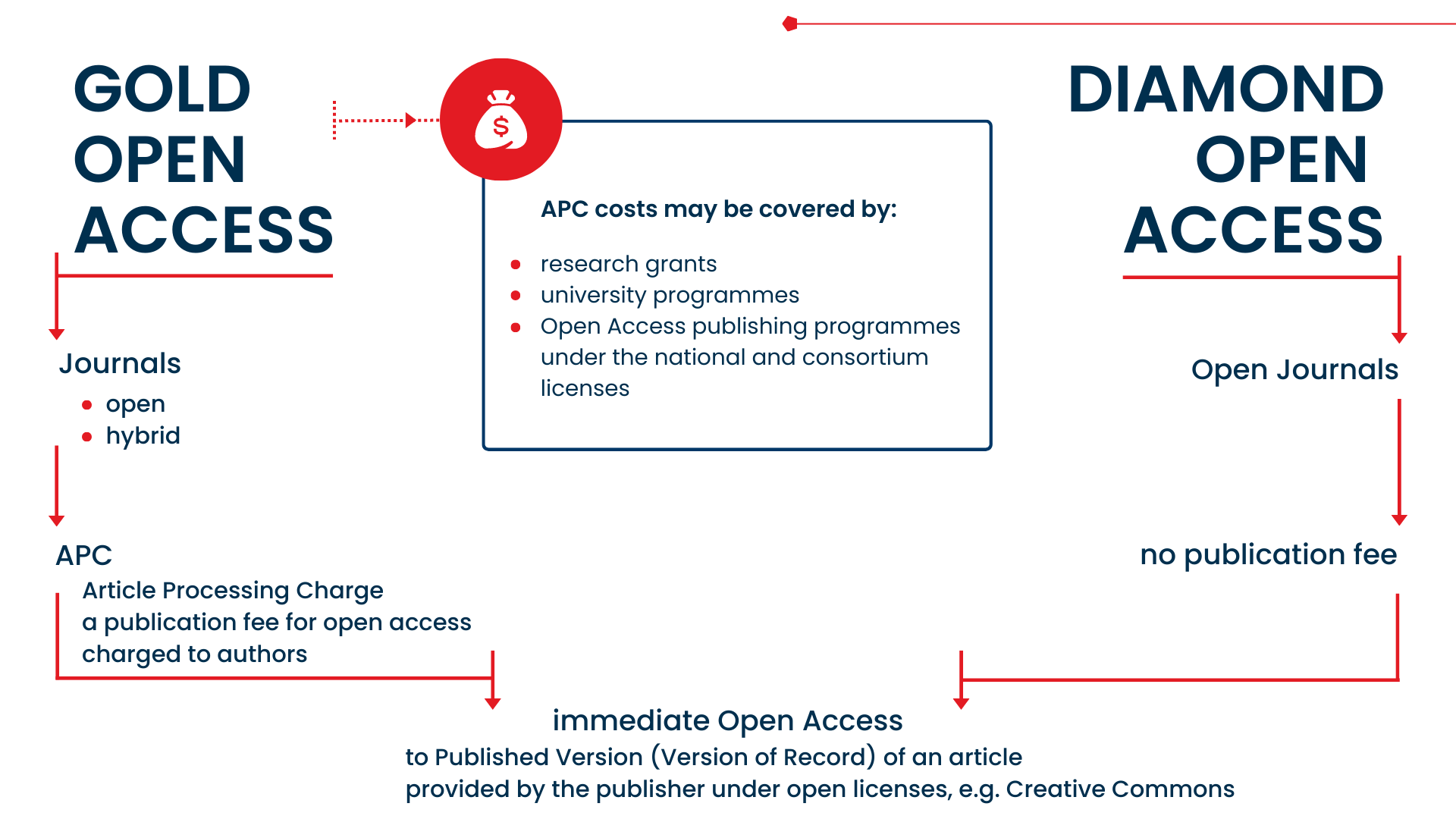
Image and information cited from: [1]
Moreover, following OA standard paths, we could distinguish two inside variants for Gold OA. Diamond OA has no extra forms. Short description below:
Full Gold OA or Pure Gold OA - there are no subscription fees in this model, and publishers earn by charging authors or institutions. These fees are known as Article Processing Charges (APCs).
Hybrid Gold OA - in this variant, authors publish in traditional subscription-based journals, but can choose gold access for their publications by paying the APC. Once the article is published, it is open to all readers. In hybrid journals, only some of the articles can be accessed in this way. Other articles which are not available through Gold OA cannot be viewed by readers who are not subscribed to these journals.
Diamond Open Access, also known as Platinum or Sponsored. Other related terms are subsidised open access publications and "no fee" journals. The term Diamond Open Access refers to open access journals that do not charge author fees (APCs - Article Processing Charges). It means that the publication is open to readers (as in Gold Open Access) and that authors have not incurred financial costs to publish in the journal (unlike Gold).
The main difference between Gold and Diamond journals is the funding model. APCs are the separating factor between the two forms of Open Access. Journals in Diamond Open Access are usually funded by the institutions and universities associated with the journal. The costs of publishing in such journals are also covered by the fees charged to those who associate themselves in consortia, as well as from grants and advertising.
Concerning the overmentioned description and image could be summarized that:
The Gold OA path - there are no subscription fees in this model, and publishers earn by charging authors or institutions. These fees are known as Article Processing Charges (APCs). The charge value, charge payment conditions (details) must be clearly presented/stated for Author's.
The Diamond OA path - there are no subscription fees in this model and no Article Processing Charges (APCs) for scientific articles. Remark - special articles like commercials or industry-sponsored (treated as commerials) ones are excluded from this case.
Following the information displayed on our website, We state that all approved scientific articles would be published with the:
Diamond Open Access path (currently).